Sunday, May 26, 2013

high up

Bayern beat Dortmund in the Champions League last night.  They were a bit better.  They scored one more goal.  There's nothing to argue with.  Even disregarding the game, the win is deserved.  If you make it to the final three times in four years and beat Barcelona 7:0 on aggregate in the run for the win as Bayern did, you have a good claim to being the best in Europe.  For the manager who's leaving the team in mildly dodgy circumstances after this season, it must have been the sweetest victory.

The game was all right.  It started out extremely nervous, with both team highly respectful of each other and didn't gain any measure of playfulness or levity until deep into the second half when the first and then, shortly afterwards, the second goal fell.  The last twenty minutes were exciting, with quite a few hairy moments.

In a break with tradition, I didn't go to the Famous 3 Kings or The Goose to watch the game.  Instead I headed up to the Kensington Roof Gardens, a venue high up above Kensington High Street on the roof of the Derry & Toms building.  This former department store, with ambitions as high as they were absurd, sports three distinct formal gardens around a central hospitality area that together cover one-and-a-half acres of roof.  The department store has long vanished; the gardens remain.

They are not normally associated with such plebeian pleasures as the public viewing of football.  During the day, locals and tourists in the know can gain access to these gardens for free and hang out among flowers, trees, ponds, ducks, and even flamigoes, relaxing in lawn chairs and forgetting about the madness six floors down where the Gap and Marks & Spencer flog their wares, commuters flood towards the tube station and traffic soils the air.  At night, the gardens are turned into one of London's more unusual night clubs.

Last night, an association of Germans in London had rented the space for a few hours, letting us mingle almost exclusively among compatriots and watch the game in style.  This being Kensington, style came with prices to match:  20 quid to get in, twice that for a round of five drinks (one of them a coke), ten pounds for a burger from the grill.

It's not a place I'm likely to return to, but it was fun to be there.  When the game was over and a DJ took over, we stayed on, chatting in the Moorish garden.  The drinks kept coming despite the cost.  After all, five people equals five rounds.  The conversations were all in German, something that I don't get much of these days.  Though I write in English and probably speak English better than German by now, German is my first language and speaking it touches different nerves.  Debating regional differences in usage is suddenly not a philological exercise but a question of identity.

I've long maintained that moving back to Germany as such doesn't appeal to me.  I'm not whatever the opposite of a xenophobe is, but there are too many advantages to being a foreigner.  Regardless, the move it drawing closer; it's probably going to happen early in July.  Last night, I got an unexpected buzz about it.  Maybe being among Germans isn't so bad after all.

When we left, late for a pub but much too early for a night club, the Kensington jet set was just arriving, jostling for positions in the line that was forming by the entrance downstairs.  Even deep pockets and sharp smiles were no match for the bouncers in black.  We felt as if we were giving something up by leaving.

Tuesday, May 21, 2013

progress

In September of 2000, if memory serves me right, I went to Mexico for the first time. It could have been in 1999 or 2001, but I don't think so. 2000 sounds about right. My sister lived there for a couple of months on an internship and I turned the benefits of a local contact and company on the road into a week's vacation. It almost ended badly before it even began.

I had been working hard in the weeks leading up to the trip, as graduate students do, racing to the airport pretty much straight from the bench. I'm making up the details because it's been so long but I clearly remember a layover somewhere in California and the thought that maybe I should have reminded my sister of my flight information. I had sent her everything weeks earlier, but there were no emails or phone calls after that. Had she written it down? This was the time before ubiquitous internet and smartphones – or indeed a cell phone for me. And it was a time when I still believed that every bit of information need only be transmitted once.

In León, after an unchaperoned walk across the tarmac, from the plane to the little terminal building in the distance, I picked up the car I had rented but my copilot, essential when mapless in unfamiliar surroundings, was nowhere to be seen. I test-drove the Tsuru around the airport parking lot, getting worried with the sinking sun. I had no address or telephone number, and no peso for the night.

My sister was there with an international student organization. Out of options, I hit the road towards town trying to find a university. The story would normally continue here. It's a good one. I'm laughing as I'm writing this, recalling episodes and encounters. But this post is not about the trip to Mexico. It's about Yahoo! Mail, which was down when I finally rustled up a computer after a few longs shots had hit the target.

To say I was shocked is putting it mildly. I had been with Yahoo!, the first web mail of note, for two-and-a-half years and never been disappointed. Email was my last hope, and Yahoo! let me down. This story, which turned out well thanks to a few late strikes of good luck, came to my mind when I was checking a reservation the other day.

mail down
Yahoo Mail! going down

Yahoo! Mail was unavailable for a little while only. What came afterwards is much worse. The content of some emails disappeared from my inbox. The header was still there, the placeholder saying that there was an email, but clicking it didn't open it. Instead I got the following window:

mail down
Emails getting lost

Now I know that one doesn't use Yahoo! for anything serious and I admit that this is only my spam-ads-and-other-random-stuff account. But, being an early adopter and all, I'm rather fond of it, and I would like it to work. Essential flight information that remained concealed added a certain spice to my feelings about this.

This all happened last week. I took the screen shots, including the one with the proposed solution – of mind-boggling complexity – that's not reproduced here, with the thought in mind of turning this into a post. I was going to bitch about Yahoo! and how they keep getting worse though that's hardly possible when out of nowhere, their only services that's any good, Flickr, is going big.

I've been putting photos on Flickr since early 2006. I liked their interface and their focus. No social networking, no location services, just photography. I've always been too cheap to go Pro. The most recent 200 photos that were visible on the free account were enough for me. But today, Flickr totally changed the game, unlocking all accounts and giving every user 1 TB of free storage. All photos I've ever uploaded are accessible again, way back to Istanbul seven years ago. Way to go!

Sunday, May 19, 2013

civilization

The first thing I noticed as I descended from Terminal 4, the gateway to obscurity at Heathrow, is engineering works. This is what defines London on weekends. Underground public transport shuts down in long stretches to facilitate the replacement of bits of track or signaling that have done their duty faithfully over decades. The tube has just celebrated its 150th anniversary, and some of the hardware hails from that initial period. There's a (potentially apocryphal) story that tube maintenance workers sometimes query the archives of the Science Museum to replace crucial bits of kit that have just failed.

This afternoon, the Piccadilly line existed in three separate segments that disconnected parts of London that don't have much to do with each other but I rather fancied as waymarkers on my final hop home. There was no direct train to London save the Heathrow Express, a ripoff for anyone who doesn't specifically want to go to the Paddington area. The tube from the airport didn't run beyond Northfields. The name already gives it away. This is not the place you want to be stranded.

I got off at Boston Manor where instructions were posted all over in black felt pen: Rail replacement buses were running to Ealing Common for connection with the District line, up and down the length of the Piccadilly line, serving all intermediate stops, and direct to Earl's Court for those with ambitions beyond. From Earl's Court, it's only a short walk home for me, and my backpack wasn't heavy.

Returning to civilization as I know it after four day in an exciting but rather unfamiliar place, the orderliness and regulation of London are striking. What looks like chaos and dysfunction when living through it is an example of sharp structure. All over Boston Manor were tube staff directing confused travelers, many coming in from abroad, some for the first time. Patiently they answered the same questions again and again, repeating for extra assurance what was already written down on big white boards at the tube stop exit. For buses to Earl's Court, cross the street. For buses to Ealing Common turn left. I crossed the street.

An orderly line, this most British of crowds, had already formed. The tourists, still dazed by airport security, joined in most naturally. Presently, a red double-decker arrived, and two manhandlers started triaging passengers by the heft of their luggage. Light goes up, heavy stays down. Two minutes later, the bus took off, running down the A4 without stopping until it got stuck in traffic at Earl's Court, pretty much right in front of the tube station. I brought my Oyster card up to date at the touch terminal and arrived at home ten minutes later.

Had the bus not been heated as if were still the middle of winter and not, as it happened, a most splendid summer day with sun insinuating itself through the clouds on occasion and the temperature reaching a toasty 15C when it did, I wouldn't even have broken a sweat.

Wednesday, May 01, 2013

aide mémoire

In August 2001, I visited the White House.  This is what my sister claimed in a rambling discussion after the Sunday night crime drama that's mandatory TV watching in Germany.  I argued passionately with her.  It couldn't possibly be true.  I had no memory of this at all.

On Thursday, I had flown to Munich for a few days of escape, to get away from work and from the noise and dirt of the big city.  Munich is big in Germany, but it feels like a village, a village that has just been hosed down.  Everything is quiet, clean, in order.  My sister lives on the southern edge of town, near parks, the river and the zoo.  It's like a permanent vacation.

Every day, once the little one was fed and otherwise taken care of, we took off on a little excursion, on foot or by bike.  The destination was always the same and always different.  We followed recommendations in my sister's beer garden guide.

In Bavaria, beer gardens are institutions of quasi-religious significance.  Their design and mode of operation are strictly regulated by tradition.  Deviations are met with public disapproval and commercial defeat.  Beer gardens must be in the open, with large wooden benches along wooden tables under old chestnut trees.  There is self service and you are allowed (but not required – the grill is always on) to bring your own food to consume with the beer on tap.  There's always a play area for kids and plenty of bike parking.

In four days, we visited four beer gardens, one down the river, one up, one in a small forest nearby and the last one way down south near the Alps, at the foot of mountains as mighty as only mountains rising from a plain stretching endlessly in three directions can be.  This last one was part of a monastery and the beer came, as in so many beer gardens associated with monasteries, from the brewery on the premises, run by the monks in a dual effort to augment their finances and win the locals for their cause.

On the fifth day, spent in town, we stopped at a coffee shop that was only notable for its spaciousness – it was one of few places large enough to park a pram – and a tradition, barely established, seemed broken already, but it was rescued, a few hours later, at the airport.

Munich airport is not very big and rather quiet, much like the city.  Between the two terminals is an open-air plaza surrounded by shops on the ground level and offices and conference facilities higher up.  It looks like a real-estate developer's dream of urban renewal – artificial and soulless.  It would be absolutely dreadful anywhere else, but on an airport, it's a little bit of paradise:  open, with space to breathe and stretch your legs, and the real sounds of departing planes instead of the constant artificial hum of enclosed commercial spaces.

In one corner is a large beer garden that benefits from its own brewery, on-site, at the airport.  I don't know how much of a gimmick this is – I got a Hofbräu instead of their own – but it's pretty cool in any case.  I had an hour to kill and did what I hadn't done earlier, sitting down on a long wooden bench, ordering half a beer and half a hock, and enjoyed dinner.

Then I was thinking about the earlier conversation with my sister.  She had been right.  There was photographic evidence, white columns towering above a much younger version of myself.  I had completely forgotten and can still not recall any specifics.  It was at a time when security screening entailed little beyond a jovial "How you doing, folks?  Enjoy your stay."  Maybe the terrorist attacks three weeks later had purged my memory.

My sister knew because she had documented her semester abroad in a scrapbook of photos, tickets and maps.  I sometimes imagine my blog fulfilling a similar purpose, sorting memories even when I don't remember them.  But it's not the same.  Some of what's published here is distorted.  Much more isn't mentioned at all.  The blog is not comprehensive.  Memory should be.  Diary, anyone?

Sunday, April 21, 2013

remote data

In complete ignorance of the world around it, work goes on as usual, at least for the time being.  My last day at Imperial will be 30 June, but the imminence of that date is impossible to tell.  Left and right, people leave and arrive.  The composition of the lab changes; my lunch-mate was the latest casualty last week.  Only very few of those that were around when I arrived are still around.  I'm doing my work like in a bubble.

What else is there to do?  Scientific projects never end, even when the funding ends.  There are always more questions than answers, and every good answer triggers a load of questions if a thinking person gets the answer.  This is the way of science.  Somehow, the personal tends to play second fiddle to the professional, for whatever elusive reward.

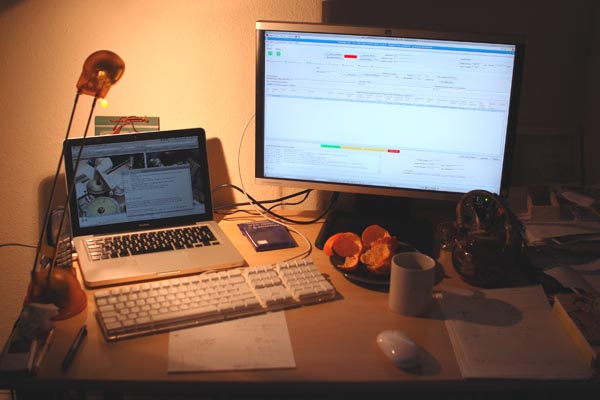
Yesterday, I absconded from the lab with a 24-inch screen under my arm, unnoticed by security, unchallenged.  I waited five minutes on Queen's Gate until an unoccupied black cab came by and picked me up. Six minutes later I was at home. I swiped the chessboard off my desk and moved the few chess books and the openings encyclopedia that I've acquired over the last year and that now clutter its surface in dismal neglect aside and assembled scientific infrastructure in their place.  The tired MacBook, an old keyboard, a mouse (mighty by name but painful to use), and a few feet of cable to connect it all.  Then I went to bed.  It was not even ten o'clock.

My alarm raised me shortly after one.  Far away in Oxfordshire, the earlier shift was coming to an end.  Colleagues there were about to pack up their things and rest.  I had seven dark hours of forced wakefulness ahead of me, the twelfth session at the synchrotron in nine months and the first time of collecting from home.  I was curious about new crystals but also, on a more fundamental level, how data collection would go from home.

At the synchrotron, one sits outside the experimental hutch and, with the help of graphical user interfaces and movable cameras, adjusts experimental parameters, controls the sample-loading robot, positions the sample, and collects data.  When there's a problem, a beamline scientist is only a phone call away.  It shouldn't matter where exactly "outside the experimental hutch" is, as long as the network is fast enough. A coffee shop or my living room should do the trick just fine.

It turns out that the network was a bit of a problem.  Despite plugging the computer into the router to avoid wireless congestion, which often slows things down, the interface responded only slowly.  Measured 10 Mb/s is not enough for smooth sailing.  Buttons only slowly materialized on the remote screen.  Efficient clicking required anticipation and a memory of where each function was.  It was awkward but good enough to do the experiments.  Had I worked from my desk at work, I could have screened a few more crystals, but in the end I got I needed.

The experience was much unlike being at the synchrotron where time stands still, the light is always artificial, and a barely tolerable drone persists.  At home, you don't need a clock to tell the time.  At five, with audible though never irritating purrs, planes started descending into Heathrow.  Shortly before eight, the first bus stopped outside my house.  (The night buses must have passed by the stop.  I never heard the rattle of their accelerating engines.)  Then, at nine on a sunny Sunday morning, the justification for doing it at home:  the pleasure of falling into my own bed five minutes after the end of the shift.

desk
Towards the end of a long night

On Monday, in the lab and with the necessary computing and graphics power for data analysis, I will find out how much closer I've come to some sort of closure to the project I'm working on.  The structures that will rise from the data collected last night will certainly complement what I've found so far.  If all jells into a cohesive story, I'll have a strong case for employment in another lab in the future, and things will at last come to an end.

Sunday, March 31, 2013

coffee music

The Sunday morning coffee concerts at Wigmore Hall are an institution and a fine way to experience time travel.  Every Sunday at 11:30 the hall plays host to a soloist or a small ensemble for a concert of just about an hour.  Depending on the week, there might be piano sonatas on the program or lieder, string quartets or a clarinet trio, Bach's cello suites or something obscure by someone unknown.  I never check the program before I go:  The music's always great.

The pleasure doesn't stop at the ears.  Wigmore Hall was built around 1900 and decorated in the taste of the times.  Throughout the concerts listeners can feast their eyes on the big mural at the head of the hall and in the dome above the stage extolling the divinity of humankind, rays of progress, the new man.  I'm always vaguely reminded of the communist hero depictions I grew up with.

To complete a triumvirate of sensory experiences, after the show, the audience is invited into the basement café where tickets can be traded for glasses of sherry or, for those of austerer disposition, coffee.  Inspired by music and enlivened by alcohol, the grey-haired crowd mingles and contemplates in which leisurely way to spend yet another quiet Sunday.

It is here that time travel comes into play.  All through the concert but especially at this coda, I feel like 80, blending in with those around me, and start imagining the days of my retirement.  Breakfast cooked by the staff, a concert at Wigmore Hall, a stroll through Regent's Park and up towards Primrose Hill for lunch, and then somewhere lovely for tea.  Ta-ta, life is good.

Today it was easy to shake of the delusion of premature aging.  It was, to sing the refrain to a song that's getting increasingly tiresome, cold and blustery.  As I left the venue, still under the graceful glass-and-iron canopy that protects the entrance, all thoughts of leisurely strolls were blown from my mind.  I ran to Bond Street and hopped on the tube, off to activities more suitable for my age.

Tuesday, March 26, 2013

four times

I've mentioned before that in the five years that I've lived in London, three companies have tried and failed to turn a direct air link between London and Dresden into a financial success.  British Airways flew for a year in 2007/2008, from Gatwick.  Lufthansa held on for two years and only abandoned the project when they sold British Midlands, their subsidiary that operated the flights out of Heathrow.

Late last year, OLT Express, an upstart budget airline entered the market with a whirl of, as the late Douglas Adams might put it, no publicity at all.  Their ineptness led to one of the swiftest corporate meltdowns I've ever witnessed.  As they abstained from marketing, no one knew about them and hardly anyone flew.  I was one of the few, but only for one leg.  Lufthansa bailed me out on the return trip, when OLT Express simply vanished.

After arriving at my home not much later than I otherwise would have (thanks to the quicker ride from Heathrow compared to Southend), I fired off an email outlining my rights as a passenger under EU regulations.  If your flight is canceled, you're owed compensation.  OLT Express eventually replied with the offer of a return flight to anywhere on their network, which I declined.  There weren't many places to go and, anyway, tickets were cheap.  I'm double happy that I insisted on the 250 Euros because seven weeks after I got my money, OLT Express folded.

One day before I pocketed the compensation, Air France announced it would fly its subsidiary CityJet between City Airport and Dresden from spring, "complimentary drinks & snacks" included.  Fourth Airline, fourth airport, fourth attempt: There is much to be learned from the mistakes of others.  My dad tells me that the rolls he buys for breakfast come in a paper bag with information about the new service stapled to it.  Here in London, the Evening Standards contains daily advertisements.  Could this be going well for a change?

The service hasn't started yet, but I'm already pessimistic.  It's not that experience has taught me or that three times a charm but four times's cause for alarm.  No, it's that the service will start on the first of April, the day after Easter, thus obviating financial gain from eager holidaymakers.  I give them half a year.

Sunday, March 24, 2013

saint patrick

The trip was bound to be a good one; I was looking forward to writing about it afterward.  The excess of St. Patrick's celebrations in the middle of the Christian austerity of Lent, a day of unrestrained drinking interrupting forty days of penance, penitence and repentance.  Ireland is a very Christian island.  I was wondering how the the contradiction would be squared.  My observations would be done in the north, on the fourth green field, as the Irish say nostalgically.

Over the years, the Northern Irish have become used to squaring contradictions.  Just a few decades ago bombs would go off on a weekly basis and people be killed regularly for reasons that don't need rehashing here.  Let's just say that the situation calmed considerably with the signing of the Good Friday agreement fifteen years ago.  There were still Unionists and Republicans, nationalists and loyalists, Catholics and Protestants – which are, by the way, not ingredients to a Venn diagram of the conflict but various ways of looking at the same two sides – but they decided to get along and try to make things work.

Things have worked for the most part.  Outside the occasional riot, recently flag-related, Northern Ireland isn't much different from the rest of the UK.  Police stations still sometimes resemble set pieces from Total Recall, but the fortifications are coming down.  Replacing the Royal Ulster Constabulary, which was considered biased, even sectarian, with the Police Service of Northern Ireland went a long way towards building trust in the communities, and more relaxed security has been a result.  Another was the turning of Belfast from a city under siege to one of great economic promise in the early 2000s.  Now it is under economic distress like any other medium-sized city in the UK.

When I flew to Belfast last weekend, it was not only to quench my curiosity but also to see a friend of many years.  Culturally, he has nothing to do with Northern Ireland or the conflict.  Luck of the bad kind (denied entry to the country of his choice) and the good kind (an eager employer offering him an alternative to the job he couldn't do anymore) combined to bring him to Northern Ireland more than five years ago.  Now married, he has a small family and is unlikely to leave anytime soon, but he remains an outsider without passion or prejudice.

My friend lives in a terrace of British looking houses, narrow and tall and stacked side by side with no space going to waste.  Who needs a yard when it rains all year?  There's parking in the front and the next terrace in the back.  Inside it's cozy and cute and dominated by staircases.  I slept high up in the attic.  It was raining all night.

It continued to rain throughout the weekend.  It was also windy and miserably cold.  Divis mountain was covered with snow.  Every step outside was a challenge, and we didn't do much besides shuttling between St. George's Market and Caffè Nero, between restaurants for dinner and pubs for drinks.

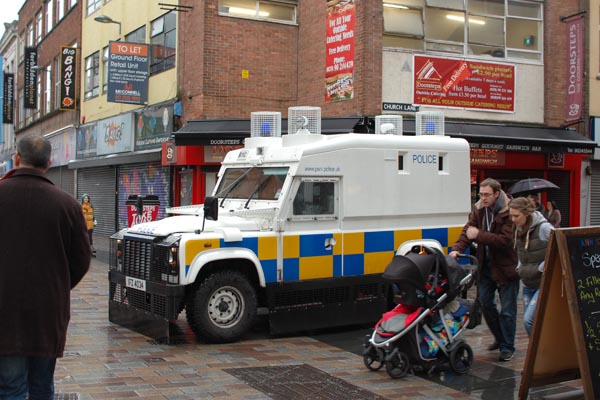
At first glance, a visitor to Belfast notices nothing of the troubled past.  Then a garish white-blue-and-orange police Land Rover slowly rolls into view, heavily armored and with wire mesh protecting its windows and emergency lighting.  Among the doleful shoppers in a slightly dilapidated pedestrian area, it seems wildly out of place, but like cosmic background radiation, which testifies to the Big Bang fourteen billion years ago, it's a reminder of what used to be.

santons
Not an ice cream van

The conflict isn't over.  When Belfast City Council voted, on 3 December of last year, to restrict the flying of the United Kingdom's flag to certain holidays, loyalists objected on the grounds that this constitutes a grave disrespect to their country.  Protests, sometimes exploding into riots outside City Hall, have been simmering ever since.

When I was there, all was quiet, though it seemed to me a particularly propitious day to protest.  St. Patrick's day, the holy day of the patron saint of Ireland, is a celebration of Irishness and green and pride and, by extension, everything that's not British.  In what seemed to me a blatant display of cultural insensitivity, the Union flag flew over City Hall.  Youths shrouded in the same flag or wearing it printed on leggings as we saw that night are perceived as provocations.  But St. Patrick's day was chosen by the Council as one of the days to fly the flag.

On Monday we went to the Titanic Museum.  Titanic was built in the shipyards of Harland and Wolff, on the right side of the river Lagan, just across from central Belfast, but what should be a major tourist draw was for the longest time ignored with considerable embarrassment.  That the boat only sailed for five days might have had something to do with it.  That it took 1500 lives when it sank might have contributed as well.  But in 2012, a hundred years after the disaster, a shiny new museum is dedicated to the construction of Titanic and the historical context of industrial Belfast, the world's dominant supplier of linen before shipbuilding became big.

The museum is spectacularly designed and pulls out all the stops, trying hard to justify the eye-watering admission prices, but it falls short when the actual sinking is concerned.  Whose fault was it, I want to know.  Was the recklessness of the captain, so eager for the fastest crossing of the Atlantic that he ignored warnings of icebergs, to blame?  Was it the operator's delusion of the ship's invulnerability?  Was the shipmaker negligent in implementing safety features?  Who decided on the number of lifeboats and vests, and who was responsible for evacuation procedures?  After three hours immersed in history coming alive, these questions remained unanswered.

Also unanswered remained my questions about boozing to the hilt during Lent.  Due to the demands of the wee one, we missed the parade.  Later that day, my friend and I checked out various pubs downtown and near the university and had a pint here and there, but where was the party?  The mood around us was rather subdued.  People were drinking as they would be on any other Sunday, meeting friends, chatting.  There were silly hats and little plastic shamrock flags but no brawls and no puking in the streets.  No one appeared drunk.  I was left a bit disappointed.  What would I write about?