Wednesday, November 01, 2006

blue screen of death

The other day, my office mac got an internal facelift. OSX was upgraded from beta 3 to beta 4 (aka 10.4.8). I was stoked, mostly because I was so fed-up with this ill-working box. Hopeful that the major glitches were finally fixed, I started some serious scientific computing, running at 100% CPU load for several days.

Before I obtained publishable results, my hopes for improvement were dashed when the screen went dark and a nice quatro-lingual notice lit up, telling me with no uncertain terms that the computer thought it had done its job and that resistant was futile. I had seen this screen many times before, and I knew what would come next. This time I was bent on preserving the madness.

restart your mac

I ran down to the lab, grabbed the digicam and sprinted back to my office where the Mac was screaming at me like a deadly injured bear. Its fan was running at full speed at a noise level that would make any P4 Dell laptop turn itself off in embarrassment.

I turned it off in anger, ending suffering for both of us. You might say Macs looks good, and you're cool when you use them. But I'm old-school. I like things to work. And the Mac doesn't.

Tuesday, October 24, 2006

freedom to insult

Today, towards the end of the afternoon, I walked down the hallway of our institute to chill for a few minutes in the sun that shone strongly through the bay windows of the lobby. I got a coffee and sat down at one of the wooden tables, greeted by several recent newspapers. Included with this weekend's Le Monde was the New York Times supplement, English content deemed fit to win the hearts and broaden the minds of the French.

My idling mind – I was on a coffee break, after all – was gripped by the line "Certain Grown Men Find Delight Rises With Rockets", below the fold but on the front page. The story was about a bunch of self-proclaimed nerds meeting in Nevada to shoot home-made rockets into the sky. I was reminded of a ballisticist friend of mine in Utah and looking forward to reading about him and his baby, Dasypygal, but they were apparently not there. (Once the googlebot comes by, this will be the only page on the known web to have the words ballisticist and dasypygal in it.)

I leafed over and was treated to Thomas Friedman's ineludible opinion. I own one of his books (purchased in off-season Malta when I was dead-bored at night), but there's only so much I can take of his I-understand-the-world-and-will-explain-it-to-you-so-be-quiet attitude. He's oftentimes dead-on when interpreting current events, but sometimes so positively wrong that it is frightening.

Such a day was today. Friedman denounces the disintegration of "Iraq in the heart of the Arab world, with its destabilizing impact on oil prices and terrorism", ably demonstrating why Americans are loathed in some parts of the world. With stupefying arrogance he predicts his own future problems but is blind to Iraq's present. The situation there has first and foremost a destabilizing effect, to put it mildly, on those who live there in chaos and amidst the violence of civil war, those who might still keep the hope that the US will, one of these days, accomplish its mission and bring freedom and democracy to the country.

I could have got all worked up, but I only had a few minutes before returning to my test tubes. I moved on and my eyes fell on this lovely title: "Freedom To Insult Needs Protection". Though the column was written with acute self-interest, deploring the difficulty to do good journalism in a country (Iraq, again) that has made it illegal to "publicly insult the government or public officials", I couldn't agree more.

The staggering number of people that eagerly declared themselves deeply offended by all sorts of trivial things was the major gripe I had during my last few years in Utah when life was truly splendid. Back then, no one defended the right to offend. In fact, people were defending the offended, one had to judiciously pick one's words, and an open discussion was often made impossible, certainly for public figures.

Luckily, Utah is reasonably civilized. Despite insults being perceived left and right, no embassies were ever stormed and no Danish flags burned. That is more than can be said for other, more brain-washed parts of this world where dissonant opinions are grave insults and broadened minds are a criminal offense. It's certainly not the French that need the New York Times supplement.

Monday, October 23, 2006

head on

After a few glasses of a sublime Faugères, I sat down tonight to watch "Head on". This movie, made by the Turkish-German filmmaker Fatih Akin, had won the Golden Bear, the top prize at the Berlin Film Festival, in 2004, and I had read glowing reviews on several occasions.

"Head on" showed on Arte, the Franco-German TV station that fills its niche with culture and is usually the more aloof the more popular culture is. They can be trusted on showing films that no one else wants to present, and often those that no one wants to see really. In artistic self-delusion, they're happily and barely scraping by. They're manna for the excentric, and this time they hit the jackpot.

Simultaneous French subtitles and two narrators that sometimes corresponded and other times didn't over mostly synchronized French but frequently Turkish lines filled the movie with an energy that would have yanked a drunk from the gutter, and there were plenty of drunks in the movie. I sat on my sofa like supercharged instead of calmly letting the Faugères sedate me, trying to keep up with too many sensations being hurled at me by a small glowing box.

The story is quickly told. A Turkish-German girl suffering from traditional Turkish values and a twenty-year older Turkish-German loser, both recently defeated in their suicide attempts, meet in a nuts-clinic and decide to get married, mostly to escape their respective miseries. They happily live their separate (sexual) lives, but slowly grow to each other. People die, people go to jail, people run off to Istanbul, people get raped and, shortly thereafter, beaten up in the streets, all over a thumping soundtrack. Turn up the volume and lose yourself in the rush.

As if guided by fate, the lovers are reunited for one last night of mad joy, before being left to weep over lost opportunites when a blunt future with no place for both of them kicks the happy end into the Bosporus. And slowly, at first almost imperceptibly, the bus leaves the lot and soon the city. Are you strong enough?

Now get up and go get the movie already. Don't say I didn't tell you.

Monday, October 16, 2006

bring back the king

For three weeks now I've been attending a two-weekly conversation circle organized by the local chapter of the Alliance Française and run by an eclectic bunch of volunteers. Despite its name, it's almost a full-fledged language class, sauf the focus is not on Grammar, and it's free. I talk less than I do in lab these days, but I learn a lot about French language and culture. And I have a great time.

Today, we spoke about history. No, hang on, Bernard, the volunteer, spoke about history, and he held the entire little group spellbound for more than ninety minutes. When I was in high-school, this was the subject I detested the most. Millions of seemingly unrelated events, all with their own particular significance. No logical flow ever revealed itself to me. Plus, too many numbers to remember.

These days I have the suspicion that history is very similar to chemistry. It is completely impenetrable to a school kid, but once you get older and start to think about it seriously, you'll eventually see the light. The bits and pieces, be it hydroxyl groups or defense forces, nucleophilic attacks or revolutionary wars, just fall into place, and everything makes perfect sense at some point.

Usually, when this point is reached, complacency takes over, and you'll slowly but inexorably lose your acumen. My vision of chemistry is getting dimmer each day spent without explaining the reactive properties of an aldehyde group to someone. In contrast, I've read quite a bit of history and I'm hopeful that the fog will clear.

That's why I was mesmerized by Bernard. His history of France started with the Gauls but was all kings shortly after. The revolution of 1789, the greatest day of the country according to popular opinion, was a complete disaster. Public order was overturned, countless were killed, the country slipped into darkness. France's best days were over. What came after it – Napoleon, one more king, an invasion by Prussia, and two world wars – fit easily into one sentence.

Bernard is a royalist. After the class, we talked a little and he complained that a president elected for seven years by a minority of citizens, a person hardly representative of his subjects, can't be expected to do anything good for the country. In light of the current president I have to concur, but I don't think that 20% of the vote, which fell to Chirac in the first round of the 2002 presidential election, are worse than the 0% that a king would get.

While I might not like having a king, I like hearing unorthodox views. Not much beats a fiercely fought argument – concluded with a beer afterwards.

Thursday, October 12, 2006

snow

Looking back today, yesterday's blog entry seems oddly unfinished. I talked about great literature and about Turkey, and I ended it by saying I should go get a new book to read, without further specification. This afternoon, after a little pointer from the news, I went to get a novel by Orhan Pamuk, a brilliant, calm writer who has the guts to stare down fundamentalists, fanatics and other assorted idiots. He's now also a Nobel prize winner. And that's how snow arrives in Grenoble a month early this year.

Wednesday, October 11, 2006

philosophy

Today is a special day. I finally finished La Peste, one of the key novels of Albert Camus. Even though there is no plot to speak of, only the plague taking unremitting hold of a city, the first two thirds of the book are an amazing read, a density almost comparable to the first 300 pages of Der Zauberberg, which cover three action-free months in the most captivating of ways. The last third, however, with the plague slowly receding and scores being tallied philosophically, seemed to stretch endlessly.

I started reading La Peste almost one year ago, on a dreary Saturday afternoon in November. The trigger was the idea a friend and I had of a vacation in Algeria. The book is set in Oran, the country's second biggest city and music hub, and was supposed to prepare me for the trip, get me acquainted with the locality and into the mood. On these counts, the book probably failed, but that doesn't matter anyway. We didn't go to Algeria.

The reason for our change of plans lay in the difficulties associated with entering the country. For naive Western Europeans it comes as a shock that a country would require a visa to be visited, but Algeria does one better. In order to get a visa, one has to have the trip planned ahead, hotels booked and train itineraries prepared. We were not in the mood for that. With the present political development of Algeria, drifting away from Europe while strengthening ties with the Arab league, conditions for a visit won't be as good as they were this spring for quite a while.

Despite a missed a window of opportunity, I have no regrets because we spend a marvelous week in Istanbul instead. Like any good vacation, this one offered plenty of what can't be found in any guide book. Flirting wildly across language and gender barriers at Cafe Munzur, for example, or being treated to tea and olives in Ali Osman's living room.

I had to think of this last encounter after reading a travel essay the other day. The writer took the Deccan Odyssey, a luxury train circling from Mumbai to Goa, the Ajanta caves and back to Mumbai. The stay aboard and all visits were splendid and nothing was left to be desired on this perfectly organized trip. Or so it seemed, because in her last sentence, the writer invalidated the many paragraphs before by writing how she talked to a member of the board service and learned about his life and culture. "Suddenly, the temples, palaces and natural wonders outside didn't matter anymore." She had finally arrived in India, on the last day of her journey.

While a professionally organized trip often sounds exciting at first, I certainly prefer beating my own path. It's time I go back to the book store to see which book grabs my attention and might direct my eyes on a land I haven't set foot on. Yet.

Saturday, September 23, 2006

the pleasure of rain

Out of the seven days I spent in Rome last week, it rained on three. This was a blessing in disguise, and not even very well disguised. I stayed with a friend outside of Rome, and when I ventured into town for the first time three days into my little vacation, rain had cleaned the air so diligently that the dust, dirt and fumes that Rome is notorious for were nowhere to be seen or smelled. It was a pleasure just strolling around and being impressed.

It was an equal pleasure snapping pictures because, even though the rain had disappeared, the clouds were only slow to follow. I enjoyed most marvelous sky and light. And I was painfully aware what an inadequate tool a little digi-cam is for taking serious pictures.

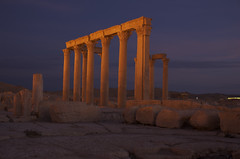
S Luca and Septimius Severus

Two years ago I spend about $300 for a small Canon, an amazing little gadget, great for taking tons of snapshots and good for an occasional photograph as well. But it is not satisfying as a main camera because:

  • It does not have a viewfinder that deserves its name. You have to hold it at arm's lenght and squint at the LCD screen to shoot. Consequently, the orientation of your image is somewhat aleatory, and a horizon at a five-degree angle is already good.
  • The camera is fairly light and sways in the wind like twigs of an aspen tree, especially if you hold it at arm's length. Forget about sharp photos at one-over-focal-length seconds.
  • Forget about sharp photos anyway because the little lens wasn't made for that. Hell, the entire toy weighs less than a serious lens alone.
  • While your photos won't be crisp as they should be you can't take portraits with a blurry background either because the pathetic little joke of a lens can't be opened far enough.

The N8008 and two prime lenses, a 28mm and a 50mm, that I used to own (before I sold it when I couldn't carry it out of the US because my bags were too full already) combined into a system that left little to be desired. The 50mm lens in particular amazed me every time I used it. I would look at something and think, hey, this would make for a nice picture, and as if by magic, my lens would capture it just right. It really improves your pictures when you don't dig around with a zoom.

Now that I'm deprived of a good thing, I'm pathologically salivating every time I read a report about digital SLRs. Today was such a day. Philip Greenspun has published an article on how to build a digital SLR system on photo.net. $1200 get you into the game, but you'll probably need twice as much if you want to add a wide-angle lens and a tripod.

The problem is, if I actually break down and buy something useful, I'd have no excuse for taking shitty pictures. And I'd have to go to places where it rains to find the right light.

Wednesday, September 13, 2006

self-flagellation

I'm sitting at home hitting my head with a big wooden mallet, inflicting pain onto myself to show how much I repent my sins, much like the flagellates did in the Middle Ages, only I'm taking it more seriously. Today I went to the Alliance Française for the first time. I thought it was about time I finally learned some French, after eighteen months of being deaf, dumb and mute, and the Alliance is the place to go. They offer courses, gatherings and the like.

Before the hard work can start, one has to undergo a test to assess one's abilities. After much sweating, flailing and winging, I was attested the language proficiency level of "avancé superieur anterieur sur-composé" or some such thing, almost falling off the sheet. The friendly elderly gentlement manning the triage ward told me I shouldn't bother with a regular course because I'd bore myself to death.

Now I have to say that I don't mind a little sacrifice here or there, especially if it finally gets me to learn some French. But there was no arguing with him. Not even the prospect of several hundred euros tuition made him change his mind. He was resolute in insisting I should just sign up with the Alliance Française for a nominal fee of 15 euros a year and religiously attend the conversations circles, held twice a week.

It was at about this time, when he told me that the conversation circle meets about forty seconds from my home, that I considered getting the mallet for the first time. Why have I not been going there for months now? My brain needs some serious reshaping.