Showing posts with label collected moanings. Show all posts

Friday, April 12, 2019

failed democracy

I don't believe in the evil of taxation without representation.  When – many years ago when I still lived in London – a bunch of aggravated American expats threw three and a half bags of builder's tea into the Thames, I had nothing but mild condescension for them. If you don't like the way things are, go back to where you came from.  This was easy for me to say.

Back then, I didn't consider myself a migrant.  I was a mercenary of science, joining labs where there was excitement and staying until the money ran out.  I didn't grow roots, and I didn't want to.  There was no sense of permanence.

Things have changed over the years and my situation and my attitude are much different now.  With a job without an expiration date and, especially, with children, I perceive my surroundings differently.  I have already written that I don't find the idea of taking up another nationality as absurd as I did in the past.  I feel a strong urge to belong, but it's not easy.

Dietikon, the town I live in, is rather underprivileged by Swiss standards.  Unemployment is around 4%, and the ratio of people on benefits is higher than anywhere else in the canton.  The town is far from the picture-perfect Alpine village one often associates with Switzerland.  It is also full of immigrants, some naturalized but many not.

When Switzerland played Albania in the Euro 2016, the game shown on a big screen on the town square.  Excitement and good spirits were all around, but more flags showed black birds than white crosses.  I cannot blame the Albanians for showing national pride and for not picking up the colors of the locals, the colors, after all, of their adopted country.  They are – all we foreigners are – welcome to a limited degree only.

At 45%, Dietikon has the second highest share of foreigners in the canton.  The strongest party on the town council and the executive is the populist and angry Swiss People's Party, a right-wing outfit of questionable values.  Instead of representing immigrants, it detests them and tries to keep them away.  How can they win elections here?

This is easy.  Only slightly more than half of all (tax-paying) residents are eligible to vote.  Foreigners, no matter how involved they are in local issues, how much they care about their hometown, how hard they work to make it a better place, are ignored.  Elected politicians, even if they came close to getting every vote from every eligible voter, represent only a minority of residents.

I accept that national elections are for nationals and that the right to vote is bestowed upon citizens only, but for local elections, this is a farce.  Keeping residents from voting in local elections – with their direct repercussions on local affairs – is a travesty of democracy.

If national law doesn't let you kick foreigners out of the country, you have to make it possible to integrate them politically.  Otherwise, you'll create a parallel society of people who don't belong, don't care, don't do.  In Switzerland only very few cantons allow municipalities to let foreigners vote locally.  Zurich is not one of them.  I will thus be disenfranchised until I apply for Swiss nationality, which is a few years off if I do it at all.  Until then, why should I care about anything that happens in Dietikon?  It's all imposed on me anyway.

At the most recent local elections here in Dietikon, just a bit more than a month ago, participation was a pitiful 25%.  How representative are the representatives, even disregarding the residents that are barred from voting?  There's an easy way to fix this.  The silent majority would be much more eager to cast their ballot if hordes of Albanians or Germans were suddenly allowed to vote – and thus threaten to annihilate centuries of Swiss culture with their savagery.  You'd probably also find, at least locally, that the important issues – development, education, traffic, crime – remain the same no matter who is allowed to cast their vote, except now decisions would have much broader support.

Opening local elections to all residents would be an unambiguous gain for democracy.

Tuesday, April 09, 2019

comfortable reading

The other day in Leipzig, I went into the huge bookstore next to the university to buy entertainment for the flight back to Zurich (and possibly any number of successive flights).  Strange how unappealing the seat-back screen is when you're not up to date with the movies anymore.  The books I had in mind, my personal shortlist of recent smash hits, were all bound in hardcover.  This is not very practical for traveling.  The only softcover I looked for was Dostoyevski's "The Brothers Karamazov", at 1200 pages not exactly a lightweight either.  It was then that I remembered the e-reader lying ignored in some dark drawer.

My mom had given me the gadget for a birthday a few years back.  I had read a few books on it but never really got into it.  Why would I spend the price of a good book to just get a file in return?  This is not my kind of reading.  But for traveling with Dostoyevski, a file sounded just right.

Back in Switzerland, I went hugendubel.de, my source for German books.  They had a few hits matching my search.  There was the current translation at 15 euros and a handful of older translations out of copyright that could be had for a euro each.  After an exhaustive study of the relative merits of the various translators, I decided I wouldn't be able to tell the difference anyway and went with one of the cheap options.  "This item cannot be delivered to Switzerland," is not what I expected for a file.

To help the online retailers in their feeble efforts to sell me things, I went to orellfuessli.ch, Switzerland's biggest booksellser, hoping for better luck.  I found nearly the same selection, at comparable prices, as on the German website, but then started to think.  If this new translation is really better than the others, as many claim, I might as well splurge for it.  At the cost of two Economists, it would keep me reading much longer.

The transaction was quickly finished.  The book showed up in my online bookshelf and invited me to start reading right there in the browser.  That had not been the idea.  After a while I figured out the download.  That's where the problems started.

In the Guardian, a number of British authors were just bemoaning the fact that a fifth of all ebooks were pirated and that the government, the "morally bankrupt government" wasn't doing anything against to stop this.  Not only are writers cheated out of their deserved rewards, literature itself was also suffering as a consequence.  Two thumbs up from me.  Why would you not just buy your ebooks legally, download it to your reader and immerse yourself in written beauty in seconds?

Here is why not.  My e-reader, a Tolino Vision 2, is not recognized as a removable storage volume by any of the computers I own.  It will only talk to hugendubel.de natively because that's where it was bought.  Connecting to my just opened account on orellfuessli.com through the pre-installed browser failed because of unspecified technical issues.  Trying to open the Tolino's own web reader was met with an unsupported browser error.  How can the browser that's installed on the damn device fail to open the online library written for it?  By now I was getting rather aggravated.

My next long flight is still a few weeks away, but I don't want to have to leave without Dostoyevski's many words.  Adobe Digital Editions might be a solution, but I don't see this as very likely if the reader isn't recognized as a USB device.  Dropbox came to my mind for data transfer through the cloud, but this would require digging out credentials that might not work anymore anyway.  Then there's the option of linking my accounts at hugendubel.de and orellfuessli.ch to make my purchases visible to both.  Could this work?

For now, the file is online, on my two laptops and on one USB stick.  In a few weeks, it'd better be on the Tolino as well.

Saturday, March 24, 2018

half dead

It started innocuous enough.  Three days ago, I noticed a light itch on the lower part of my face, two curious spots on my hands, and a discomfort between my toes as if from athlete's foot.  The itch went with a bit of skin discoloration, suggesting an allergic reaction to shaving that I've never had.  The spots on my hands were circular, with a white center and a deep red periphery.  They were about 4 mm in diameter.  Upon inspection, there was nothing odd between my toes.

Had these three symptoms not appeared at the exact same time, I would have dismissed them without a second though, gone to work and waited for things to improve.  Time heals most ailments better than much else.  But the strange synchrony kept me wondering.  What was going on here?  The next morning I did something I hadn't done in years.  I went to see a doctor.

The Swiss health system is a strange place.  Health insurance is mandatory.  This doesn't just mean everyone needs health insurance.  It means everyone is obliged to register with the national health insurance system that consists of what feels like a hundred providers competing for clients.  You have to choose one of them and prove to your local authority that you've done so.

The morning I went to the doctor, my condition had changed somewhat.  Yellow puss had started to appear on my chin. It had done so in small quantities and dried quickly, but it didn't look pretty.  That's when my family started avoiding me.  The soles of my feet felt as if a million small needles had been inserted in them.  Walking was a murderous pain, but I could still not see anything wrong with my feet.

I had picked my health insurance for its price.  All providers are required by law to offer the same benefits.  The differences lie in customer service, ease of obtaining reimbursements, and the availability of mobile apps and the like.  The monthly premium is calculated based on age, place of residence and deductible, the amount you have to cover yourself per year before your insurance kicks in.  There are no discounts for insuring an entire family and no employer contributions, but since premiums are income-independent, they are relatively low if you earn well.  My own contribution is less than what I paid in the UK.

I decreased my contribution further by accepting to have my freedom to choose a physician curtailed.  For every illness, unless in an emergency, I'd have to consult my family physician – who would pass me on to a specialist if necessary.  Being new to the system, I didn't have a family physician, but the walk-in clinic next door offered itself – with no appointment required and, it turned out, hardly a wait.

The assistant doctor was quick to diagnose something like foot and mouth disease, even though my symptoms didn't exactly match Dr. Google's.  I had no fever, no painful throat, and no pustules on hands, feet or in my mouth.  Plus I wasn't ten years old.  Still, the soothing words of the medic comforted me.  "Just rest a bit", she said.  "You'll be better in a few days.  Concern is only due when worms are starting to emerge from the spots in your face."

The concept of a deductible sounds rather strange with health insurance but it's common practice with car insurance.  And as with car insurance, you have to trawl the new year's offers to identify the best deal and switch health insurance if necessary towards the end of every year.  It sound unnecessarily complicated and rather inefficient to me, but it seems to work well – just like Switzerland in general.

I hobbled back to my flat and stretched out on my sofa.  I had a certificate of incapacity to work – one beautiful long word in German – and no other option that to lie flat and wait.  By Friday afternoon, most needles had been removed from my feet and I could walk nearly normally.  In return, my hands felt as they had after the Challenge Dauphiné when I had cycled for seven hours through freezing rain.  Back then I couldn't open buttons or turns keys with my debilitated hands for a week at least.

Today, the changes continue, for the better for the most part.  My feet are almost fine.  My hands have become speckled with hundreds of dark red spot, some large and translucent like a bag of old blood, but they've got some of their strength back.  The dried puss on my chin is falling of.  My body feels weaker overall than yesterday, but there are no worms.

With the sun shining strongly outside on what feels like the first day of spring at last, my hope runs high that tomorrow will be beautiful, spent by the river or on a ride to the convent where the children can see rabbits, cows, pigs and sheep.  I might not look it, but I consider myself back to normal already.

Tuesday, February 20, 2018

reversal of fortune

On the one hand, there would be £350 million a week to spend on health care, full control over all and everything, and a once-in-a-generation moment to shape the destiny of a country.  On the other hand, there's the feeble reassurance that the country won't be plunged into a Mad Max-style world borrowed from dystopian fiction.

If you've guessed that the statements above relate to Brexit, you've kept up your Brit-watching over the last two years or so.  Britain has decided to rid itself of the strangulations of the EU and march into a bright future.  That's what the leave campaign promised, and that's what the first three statements above reflect.  This was the mood of the leavers before the referendum.

The year and a half since the country voted to leave the EU haven't exactly gone to plan, assuming there was or is a plan.  It doesn't much look like it.  British politicians occasionally visit Brussels to figure out if there anything good for them for when they're not part of the club anymore, only to leave empty-handed.  They've yet to visit with concrete ideas or suggestions to shape the process.

Consequently, it looks as if it's all going down the drain.  There doesn't seem to be a week without revelations of what won't be wonderful in the future. There was the story about Britons needing new licenses to drive abroad because their EU licenses won't be accepted anymore.  A nuisance for vacationers, for sure, but hell for hauliers.  There's just a few hundred commercial permits to the EU for thousands of trucks.

Then there is the staff shortage at the NHS.  It doesn't help that Europeans are leaving in large numbers as long as their post-Brexit migration status is unclear.  Lastly, Kentucky Fried Chicken is temporarily closing hundreds of outlets because of supply problems.  Ok, this last one wasn't related to Brexit, but you get the picture.

It is going to be a total disaster, which is probably why David Davis, the government minister in charge of the process, today tried to reassure an apprehensive country.  Far from the lofty promises before the referendum, Brexit won't be like Mad Max was the best he could come up with.  It's not the brightest prospect, but it's probably all the country can hope for.

Tuesday, January 23, 2018

happy anniversary

Trump is a complete idiot.

Most people probably voted for Trump for the entertainment.  It's like reality TV, but for real.  Trump does the deranged clown, and the masses can laugh and cheer.  After one year on the job, he is unlikely to have disappointed anyone.  Those repulsed by his ways see themselves confirmed anew every day.  Those who picked him for the wrong reasons would probably do so again.

It doesn't matter that he hasn't built a wall against Mexico with his own small hands and that the American taxpayer will pay for this wall, should construction ever start.  No one cares about the wall.  His tweets are a scream.

How good an entertainer Trump really is can be seen in the sad demise of Saturday Night Live.  This used to be the epitome of political comedy.  A few weeks ago, the Federal Communications Commission had to reclassify it from humor to factual.  What used to be hilariously satirical is now documentary – though no less hilarious for it.

When Fire and Fury, Trump's anniversary gift, was released the other day, I read an interview with the author Michael Wolff.  He claims to just have walked up to the White House one day with the suggestion of covering the first 100 days of the presidency for a book.  No one was responsible for books, and no one showed him the door.  In a move that would have awed Tom Yates from House of Cards, he remained for 200 days, turning to inventory whose presence is not noticed or questioned.  He apparently picked up the best parts by overhearing conversations while waiting in obscurity for appointments that never happened.

The book reveals an angry child with staggering insecurity.  Trump's afraid of being destroyed by anyone and everything.  Fighting back is his default mode of operation (mostly through words rather than actions).  Wolff claims no worries of revenge because of Trump's short attention span.  He only focuses on what's in front of him – as long as it is in front of him.  When he engages in politics, it's in unrelated fits and starts.

There's no vision and no strategy.  Like a monkey throwing darts at a wall, he sometimes hits the target, but what looks like the first step towards success always turns out to be haphazard and of no consequence.  Trump started his job by talking to Taiwan as if it were a country.  This sounds sensible if you ignore diplomatic conventions that only exist because they've existed for ages.  As part of a foreign policy, it would start interesting discussions and might break the deadlock across the Taiwan Straight.  As a monkey's dart, it was soon forgotten.

There have been many more darts over the first year, and a few nuclear hand grenades as well.  They landed to great effect where no one would have expected them.  There were even some legislative accomplishments, though they need an unorthodox perspective to appear as successes.

If you think that earning less than $100k is un-American, the tax reform bill makes perfect sense.  There's simply no reason why anyone choosing to earn less should be rewarded.  Same goes for health care.  Instead of pitying the poor, Trump wants to liberate them from the yoke of socialized medicine.  If you don't want to have to choose between treating an illness and feeding your children, do your patriotic duty and earn a respectable salary.

The masses continue to cheer.

Saturday, September 02, 2017

one German last name

A few months ago I watched a hilarious Spanish movie called Ocho apellidos vascos, which centered on the concept of Basqueness.  To count as Basque, one needs to have the eight Basque last names of the movie's title in the family, i.e. all eight of one's great-grandparents need to have been Basque.  To have any sort of future with his Basque obsession, the Andalucian protagonist needs to come up with a list of eight Basque names and use them consistently.  Otherwise, grumpy dad will kick his ass back south.

As lighthearted at the movie was, there's quite a bit of darkness in the degree of racial purity claimed to be required for acceptance into Basque society.  It's a brutal system, hostile and exclusive.  Even the Nazis weren't quite that strict.  To count as Aryan, none of one's grandparents must have been Jewish, but no one asked what the great-grandparents had been up to.

The Swiss establish belonging differently.  Here, everyone has a place of origin.  This is not where the person was born, grew up or currently lives.  For most Swiss, it is the town where their family originates, frequently a hamlet up in the mountains and possibly a place they have never seen.  The place of origin is required on many official forms and might come up in conversations when people try to appraise each other.

When I first heard about the concept of origin, I naively thought it would provide an easy way of nationalistically separating the wheat from the chaff.  No matter how many rules you follow and how much on time you are, you can't be truly Swiss if your place of origin is Pristina, I thought, but it turns out that naturalized immigrants don't have their foreign birthplace as their origin.

This is explained by the curious three-tired nature of Swiss citizenship.  In Switzerland, you're first and foremost a citizen of your place of origin.  This must be an ancient tradition.  Your first loyalty was with your village.  This local citizenship gives you the right to further citizenship of canton and Confederation.

For the Swiss, this is how it's always been and not worth a second though.  For foreigners wanting to become Swiss, there are some interesting consequences.  First, you don't submit your application to a federal agency.  Your current hometown, the place where you've spent the last few years, handles the process.  Second, it's not only formal criteria that qualify you for citizenship but also the consideration of your future fellow citizens.  They will be asked to come forth and voice any objections they might have.  Third, the issuing town will become your place of origin if you're application is successful.

When we went to the local registrar's office the other day, questions of citizenship and place of origin where not on our minds.  Instead, to come back to the beginning of this post, it was the last name of our son.  Despite our best efforts at torpedoing the system, the Swiss administration had done things right.  Not being married, the mother is the only point of reference.  Our son carried Flucha's last name.

This put him at odds with his sister and presented us with a wrong in need of correction.  It wasn't difficult.  A pile of documents from three countries and an hour at the registrar's office sufficed to establish my paternity and gave our son a German last name, at least as far as the Swiss were concerned.

At the German consulate, where we had gone this week to claim citizenship and apply for the best passport for traveling, a different story emerged.  The Swiss might have done things properly and filed all documents in the right place, but no one else cares.  I save you some of the rather absurd details but over the course of an hour, our son went back to carrying his original last name, only to revert to the right one a few minutes later.  He's not even two months old, but he's had four official identities already.  And – fingers crossed that it stays that way – he has one German last name.

Monday, March 06, 2017

typically Swiss

Three weeks ago, I thought I had a topic for a post.  It was an episode that brought some common stereotypes of Switzerland in such sharp focus that I was left blinded for a few moments.  It was perfect little story.  Lack of dedication to this blog killed it.  It now turns out it was all for the best.

To drive in Switzerland, one has to have a Swiss license.  Holders of a license from what are commonly known as civilized countries have one year to exchange their license for a Swiss one.  Within that year, no test beyond one of eyesight is required to be eligible for a Swiss license.  Swapping licenses is nothing more than a formality.

This sounds sensible but the idea didn't appeal to me.  Being European, I've driven like a local while living in France and in the UK.  No one ever asked questions.  Before that, in Utah, getting a state driver's license required a written test (open book) but let me keep my license.  What right do the Swiss have to retain my license?

It was over questions like this that a year passed.  With the second year nearing its end, it was likely too late to take action.  When it says one year in Switzerland, one year is what it means.  When the bus leaves at ten past three, it's ten past three and not a quarter.  Twenty-three months after my arrival in Switzerland, the train to a new license had left the station.

Except maybe it hadn't.  A colleague at work, told about my predicament, gave me hope.  "You can do it within two years, but you have to pay more", had said.  This made perfect sense in my understanding of Switzerland.  There are plenty of rules.  Enforcement is strict.  But if you part with some money, you'll discover hidden flexibility.  In the end, reality turned out quite different.

Three weeks ago, I went to Zurich to have my German driver's license exchanged for a Swiss one.  The office opened at 7:15.  Not being as hard-working as the Swiss, I entered the building five minutes later.  A further five minutes later, I was back out, and all was done.  The clerk had taken my application form and my license, thoughtfully given me a copy for my records, and sent me on my way.  "You'll get your new license by mail within a week."

If the license had arrived exactly seven days after my visit, it would have been the perfect story of Swiss efficiency.  A job done as expected, without any faff, quickly, competently and friendly.  And who has ever heard of a government office opening just after seven?

First doubts arose on the tram ride back.  There had been no question about my arrival in the country.  What happened to the one-year rule?  Nor had any money exchanged hands.  This gave it away.  Nothing is free in Switzerland.  There would be more to this story.

Eight days after I handed over my German license, I received a letter asking me to get a medical exam if I wanted to keep a particular lorry class I had obtained all those years ago and never used.  I opted out, but then it took another four days until my license arrived.  The promised week was broken, at least in part because the clerk at the office hadn't checked that all the boxes were ticked on the form.

With a new license in my wallet, this is where the story would have ended for me, but the Swiss had other ideas.  Today I got another letter.  Inside was a bill.  The exchange of licenses was one item and hard to argue with.  The issuing of a new license was also listed, though this might have been included with the exchange in more generous jurisdictions.  Finally, an ID check brought the total into the triple figures, not something I'm particularly happy with, but at least it's in line with common preconceptions of Switzerland.  This is an expensive country.

Friday, November 04, 2016

Dutch swindle

The other day, before setting off on a family trip, I asked a colleague with a professional history in the region what were the redeeming qualities of the Netherlands.  Belgium, which sits equally uncomfortably at the nexus of regional powers not always on good terms, has waffles, beer and Islamists so rabid they make the murderous child molesters of an earlier generation seem like a minor scourge. What does the Netherlands have?  My colleague didn't know either.

I got my first idea upon disembarking at Schiphol.  Like any good airport, it has a train station in the basement.  Any part of the country is only a short ride away.  We were on our way to Den Haag.  Similar to what I had seen in Nice a few weeks earlier, the ticket machines in Schiphol only accepted cards and coins.  We paid by card and were served a pair of tickets each with a €1 surcharge imprinted on it.

Was this for using the machine?  Maybe it was for paying by card.  Somewhere I had read something like this.  The next morning, I bought our tickets to Leiden at the ticket counter.  Another pair of €1 surcharges was the result.  It turned out not to be a particular overcharge but a fee to pay for the ticket itself, as if what you were buying wasn't the right to travel from A to B but a little piece of paper.

The reason behind this is that Dutch Railways is pushing its customers to use a rechargeable electronic card much like the Oyster card in London.  However, in contrast to the Oyster, whose initial cost is refundable upon return of the card, the Dutch smart card costs €7.50, money gone for good.  As a visitor for four days only, I felt swindled.

An expatriate I spoke to felt swindled as well.  Her rechargeable card requires a minimum balance of €20 to pass through a ticket gate at the station, even though her daily journeys between Den Haag and Leiden cost only a fraction of that.  How will she recover her money when she leaves the country if she's not allowed to run the balance down?

Perhaps the swindle is the defining characteristic of the Netherlands.  No one- or two-cent coins are in circulation but goods are still priced ending in 99¢.  This is not something imposed by the government.  Retailers have elected not to use the small denominations, which remain legal tender.  For the stores' convenience, the customer has to pay.  When you buy a t-shirt at the local chain or a jar of green goo for the baby, your bill includes a cheerful afronding, a cent you're obliged to hand over to the store so it can do better business.

In Switzerland, where 1-cent coins were removed from circulation in 2007, prices tend to end in 10¢.  If your bill is indivisible by 5, at the local discounter that can't do without 99¢ prices, for example, the amount to pay is always rounded down to the nearest 5¢.  In the Netherlands, in contrast, you get swindled.

At the end of our day in Leiden – nice place by the way though the homicidal cyclists are a steep price to pay for a nearly car-free city, how they shoot, projectile-like, through streets and bike lanes, on sidewalks and footpaths, and alongside canals, with utter disregard for traffic and pedestrians, imbued by a powerful sense of entitlement that causes their faces to contort in anger when they have to slow down, and you can count yourself lucky that you weren't hit and hurt – at the end of that day we sat down in a bar and a had a drink.

Bistomath is notoriously difficult, complex enough to drive a starship, but in this case, it was easy.  We were three; each of us had had a drink.  The third drinker, by the way, wasn't the baby.  It was Flucha's sister, the expatriate mentioned above.  When the bill came, it was four items long.  This was quickly corrected and the amount reduced by a quarter.

When I paid for dinner later that night, I checked that bill as well, just to be sure.  The chocolate milk could have been there by accident.  I went back inside the restaurant the claim the difference.  It should have been €2.95.  I got my money with a friendly smile but without an apology.  When I counted it, already out of the door again, it added up to €1.95.

If there was one good thing about the Netherlands – and I haven't even talked about Hotel Patten yet where I had to ask for a vacuum cleaner because none had been used in the room for several weeks or the Chinatown restaurant, its menu entirely in pictures that bore no relationship whatsoever to the plates on the tables around us, where we waited for dumplings until we got bored and left – it's that you can order a bottle of Trappist beer at pretty much any restaurant or bar.  I know it's Belgian, but that's as good as it gets.

Saturday, June 25, 2016

leaving

Last night at City Airport, it looked a bit like a refugee camp at the border to freedom.  The airport was overcrowded, with no room to sit and hardly space to stand.  There were long lines for tables in the few restaurants, and huddled masses everywhere.  Everyone was trying to get out – the right reaction but a bit premature in my opinion.

The day before, Britain's voters had decided to leave the EU in a nationwide referendum.  Though it took counting until 7 the next morning until the final result was announced, the outcome was clear much earlier.  I went to bed at three when the gap towards Leave kept increasing.  A few hours later when I woke up, nearly a million and a half more people had voted to leave the EU than to remain in it.  There was no arguing with that, and the consequences are obvious, but beyond the surface, the situation is more complex.

A number of very clear divides go through what is still one country and increasingly unbefittingly called the United Kingdom.  England voted by 55 to 45 to leave the EU and got its will.  Scotland wanted to remain by 62 to 38 and failed.  The referendum on Scottish independence a few years back was narrowly lost, in part because of the unresolved question of whether Scotland might have to leave the EU if it leaves the UK.  If another referendum were drawn up now, the outcome would likely be different because leaving the UK would present a clear path for Scotland to return to the EU.

London, whose votes I didn't include in the numbers shown for England in the previous paragraph, would have preferred to stay in the EU, by 60 to 40.  The BBC points out that seven of the ten areas most wanting to remain were in London.  I've always argued that London would be better off outside England.  This is now truer than ever, but I don't think a serious independence movement will develop there.

As I drove down to City Airport in the afternoon, I contemplated the irony that the campaign to leave was led by the person who was Mayor of London for eight years.  Throughout this time, he gave the impression of deeply caring about this city, and was largely liked in return.  In the morning after the referendum, he was booed by angry crowds as he left his home, but London will suffer much more.

Boris Johnson doesn't care, of course.  He hitched onto the Leave campaign to pursue his own agenda.  I used to see in him a harmless clown, but my eyes have now been opened.  He is the most devious, mendacious and megalomaniac politician in the UK.  If imagining him as Prime Minister doesn't make you shiver, envision summits with President Trump.  The lunacy of it!

When I returned the rental, a middle-aged man with a sweaty shirt and a harried look tried to secure a car for the weekend.  Avis had run out and so had Europcar and Hertz.  The man was being sent to somewhere near Birmingham with hopes but no promise.  There were no cars anywhere closer.  "Busy weekend?" I asked the woman behind the counter.  "Everyone's leaving?" I was proud of my joke until I entered the airport.

Thursday, February 11, 2016

getting worse

Back in London, I kept abreast of current events, much more abreast than was good for me or sensible in any way.  It should be evident that checking the news more than once a day is a waste a time.  Such immediacy comes with no benefits.  Back in my previous job, I used to have a browser window open with a news site at all times.  Whenever thinking got too hard or I had to wait for experiments to finish, I would read little stories that would become irrelevant shortly thereafter.  I told myself I was relaxing, meditating on the world, maybe even learning something without trying, but in the end I was just stuffing useless crap in my head.

At my new job, the thinking is still hard, but there aren't experiments to wait for anymore.  Quite to the contrary, I'm usually working on at least five different tasks, most of which are crucial and need to be finished right a way – or so they tell me – keeping me busy from early to late.  I'm not complaining; the work is interesting and satisfying, and I've been weaned off news without really noticing.  When the weather is bad I get pointless snippets cut from the regional newspaper projected on the screens of the bus that takes me to and from work, and sometimes I get the (pathetic) free paper to read on the train, but that's about it.  No more time wasting.

News should be consumed in weekly intervals at most, sufficiently matured for relevance and impact.  Unless you're a journalists or the leader of an army at war, you're deluding yourself if you think more frequent updates are needed.  Consistent with this philosophy, I buy an Economist to read on the train every few weeks.  The magazine's coverage is not sufficiently deep and universal for a well-rounded picture, but it's good enough for a vague idea, and that's all I or almost anyone else needs. I might miss the terror attacks in Paris (as indeed I did until my boss emailed me the next day to ask if I, having been in Paris the night before, was all right) or bad hair guy's latest antics in the US or some earthquake somewhere, but if it's important, it will eventually percolate through.  If it's not, it won't, and so much for the better.

I could leave it at that, and it would be a fine post for the category of "pointless musings", but what has been percolating through from Syria is so horrifying and barbaric that I can't remain silent – though I don't have anything to contribute as much as questions of angry incomprehension.

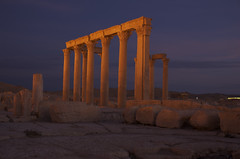
Syria is dear to meI visited it twice before the current hell broke loose, and spent wonderful vacations.  The picture on the right was taken at five in the morning six-and-a-half years ago in the middle of two thousand years of history, beauty and magic.  The rest of the country, with its welcoming people and unspoiled charms, was different in an infinity of variations and absolutely spectacular.

No one would make any kind of positive associations with Syria these days.  War – not between opposing forces but among them – has shredded the country to pieces.  I would be surprised if the columns in the photograph were still standing.  Jihadis of depravity have pillaged and killed there.  The petrified peacefulness imposed by a benighted dictator has imploded, with violence and devastation filling all space.

Every bit of news out of Syria seems to be more desperate than the last.  Half the country displaced, millions on the run from savagery, with no place to go other than camps of frigid tents in neighboring countries and very little hope.  Tens of thousands made it through Turkey last year and over to Greece and then up the Balkan route to central Europe, a migration of the dispossessed, tired masses self-organizing along shape-shifting tracks with nothing but a cell phone to guide them and a small pack on their backs.

From my comfortable flat in tranquil Switzerland, it seems impossible, unreal, that this could happen in Europe in the 21st century.  And yet it's true – a region I considered for holidays last summer has now turned medieval.  Ryanair has strung a dense net of flights across the entire continent, but here we have tattered multitudes staggering north, on foot, with no technology besides their telephones, walking as far as their feet will carry them, tired, miserable, cold.  The days repeat endlessly, the scrounging for food, the searching for shelter, the will to survive.  They keep moving and finding ways to proceed, but it's almost impossible now.  One by one, borders were fortified, fences were drawn, people were held back, vilified, sent back with nowhere to go.

Two weeks ago, when it seemed that every plague in the book had ravaged Syria and it couldn't get any worse, Putin started bombing Aleppo, a city of two million, and the world looks on.  Why is he wrecking Syria?  If he's done with Ukraine, shouldn't he take advantage of the lull and try to get the Russian economy out of the shit?  Is he trying to do just that by pimping domestic arms production?  Is he trying to swell the refugee stream in the hope of overwhelming Europe, hateful callousness that wouldn't be out of character?  How come he can commit atrocities in utter impunity?

There is no end to my questions and little understanding.  The situation is intolerable.  Fifty thousand of those who escaped Putin's bombs are now squashed against the Turkish border in unmitigated wretchedness, held inside a country that is disintegrating, a country that keeps being violated by old forces and new, by devil worshipers and by the ignorance of public opinion.  The amount of suffering is dreadful.  The inaction by those who should know better is worse.

Tuesday, November 17, 2015

religious rabies

Last Friday in Paris, three heavily armed gunmen were walking by as I sat in the Gare du Nord, waiting for a train whose platform, despite imminent departure, hadn't been announced yet.  People around me didn't pay them much attention.  To them, it was nothing out of the ordinary.  I tend to doubt the sense of deadly weapons in crowded spaces and gazed with some confusion, but I was also tired and not in the mood for internal debates.  I was on the way home from a workshop, a few hours away from the weekend.

It hadn't been the most pleasant visit to Paris.  The workshop was in the middle of nowhere, on a plateau far outside town, and I didn't set foot in the city.  The commuter train that took me there subnavigated the center, bypassing the Eiffel Tower, the islands in the Seine and the cafés of the Left Bank as if they didn't exist.  Underground and far from the light, I experienced a disturbing lack of civility.

Fare dodging is a Parisian tradition, and people breaking through ticket gates without paying is so common one doesn't have to wait to observe it.  It happens all the time.  And while everyone has to pay more for everyone who doesn't pay at all, it isn't such a big deal.  Much worse was the man who inhaled deeply from his cigarette before getting on the train, only to release the foul air inside.  Another man, a bit down and out but that's no excuse, urinated at a pillar right next to the platform, sending a flow of steaming piss washing against innocent feet.  Getting off at the Gare du Nord to change into the TGV, I was nearly pushed back into the commuter train by a crowd without the most basic manners.

Later that day, a gang of cold-blooded killers put things back into perspective.  Concerted attacks on a football stadium filled to capacity, a music hall, and packed cafés by weed-bearded cowards who rather die than answer for their crimes left 150 dead and a city in shock.  Football?  Music?  Cafés?  Why?

When Charlie Hebdo was attacked just ten months ago, some people said that "This is wrong but – they had it coming/they shouldn't have made fun of Islam/they were disrespectful".  These statements are nonsense and probably more dangerous than terror attacks to the world I live in and treasure because they threaten my freedom more than any deranged gun-wielding motherfucker.

After Friday's bloodbath, no one will speak like this.  The wanton killing of innocent people exposed the utter vacuousness of the terrorists.  There were no scores, however imaginary, to settle.  This was terror for terror's sake, murderous nihilism empty of demands.

After the attack on Charlie Hebdo's offices, the world stepped up to the challenge.  The circulation of the magazine increased by an order of magnitude.  The publishers were flooded with money, all donated so they could continue their irreverent work.  There's now an English edition to spread to joy even further.  A couple of sad terrorists had killed individuals but unwittingly launched a great advertisement campaign, with slogan, logo and all.  If they had survived their crime, they'd still be punching themselves for it.

I can only hope that this attack will have a similar effect.  The civilized world has thus far reacted with shameful hesitation and pathetic indecision to the outbreak of religious rabies in the Middle East.  Packs of deluded murderers are rampaging with impunity through large swaths of Syria and Iraq, raping and killing thousands.  If the terrorist attacks on Paris trigger a serious response, there will at least be one good aspect to the atrocity.  The world would not only become a safer place but a better one as well.

Like a rabid fox that behaves unpredictably, rabid religionists are capable of any atrocity.  There's no point debating them.  Like rabies or any other infectious disease, Islamic fundamentalism has to be fought with force, determination and persistence.  In campaigns against malaria, a scourge of humanity even more deadly than roaches from sandy wastelands, the generally accepted best strategy is aggressive protection – with nets impregnated to kill on contact.  No one would argue that we don't need to protect ourselves better.  But we also need to fight back.  Malaria was eradicated from Italy when swamps were drained and the breeding grounds of the disease vector eliminated.

A lot of the draining to eradicate terrorism must be done in Europe where the contagion persists.  Many terrorists have links to one particular neighborhood in Brussels, for example, and thousands have joined jihadist training camps from Europe.  But eventually, the unified response of civilization to the Paris attacks must focus on Syria, not only to rid the world of disease but also to bring peace to a people that's been brutalized for too long.

Monday, May 18, 2015

train of thought

This morning, the unionized drivers of Germany's national railway announced they'd go on strike for what's the ninth time in the past six months.  The strikes are quickly becoming routine for everyone not reliant on the railway, but next weekend's action kicks things up a notch:  The strike will be open-ended.  It will also be – and here's some continuity – about nothing at all.  When the train drivers announced their most recent strike this morning, what they didn't announce was what they're striking for.

It is quite clearly not about money.  This would be easy to understand and easier to communicate.  I'm sure it would also be easy to negotiate, and strike would be nothing more than a distant memory at this point. But it's not as easy as that.  The strike isn't about anything obvious; the reasons are never mentioned when the strike is discussed.

In the depth of the dark web I read something about two competing unions that represent railway workers.  One unites the drivers, the other's open to all.  As far as I understand it, the train drivers union fights for the right to represent all railway workers, whether they want it or not – a dog fight on the back of passengers.  If that's true, I'd like to punch every union official in the face, and every striking train driver as well because that's not only abusive but also deluded on so many levels that it's hard to decide where to start.

Maybe like this: If it's about fair representation of all railway workers, would a merger of the two unions not be the most powerful step?  If this has been tried and failed, the strike would be about procedural incompetence, and it should more appropriately be directed against the train drivers union itself.  The head of the union should step down for ineptitude and negligence.

But maybe the merger has been tried and failed not because of ineptitude but because the other union didn't want it.  Their voice is not heard in any of the discussions, though it should be them who decide whether they want to be represented by another group.  Otherwise it'd just be like some distant relative waltzing into your life, claiming a right to represent you as if you were a juvenile delinquent in need of guidance – and disrupting everyone else's life in the process.

Here's a geopolitical metaphor for the same situation:  Imagine you're a hapless and harmless country, known mostly for tractors, oligarchs and corruption.  Your biggest neighbor and historic rival decides it's for your best if it henceforth represented you on the global political stage.  You have a differing opinion, but your neighbor has bigger tanks.  And anyway, no one's asking you.

Even I wouldn't ask, were it not for the disproportionate misery these strikes cause.  Where there's no message, there's all the more need, it seems, to bring it across forcefully.  I'm baffled this is legal at all.  If the janitorial staff at Frankfurt airport were to go on strike, not for a well-deserved pay increase but to bolster their claim to represent, from now on, all the newsagents and bakery outlet workers at the airport, people might shake their heads.  If they, to underscore their seriousness, sat down on the tarmac and blocked all flight traffic, they'd be taken away quickly.  Why is no one taking away the leadership of the train drivers union?

For reasons that are not altogether pleasant and certainly outside my control, I have to go to Dresden this weekend.  By some quirk of scheduling, both possible Swiss flights are already fully booked.  There aren't even any seats left in business class.  The overnight train is nearly fully booked, too.  No beds or cots remain.  This morning, hours before the announcement of the latest strike, I purchased one of the last sleeper-seats.  I am not exactly looking forward to the journey, but I'm even less looking forward to having my plans foiled by some idiotic power game between imbeciles.

Friday, January 09, 2015

freedom to offend

You know my opinion.  The freedom to offend shall always prevail over the freedom from offense.  This topic has been aired here before.  I haven't much to add, but in light of recent events I had to sit down to write again what needs to be written.

If you don't like what someone says, you have two options: Argue your point to convince the other or don't listen.  If you don't like what a book is about, don't read it.  Think a film will offend you?  Don't watch it.  Cartoons mock your prophet?  Have faith that god "is about to gather hypocrites and infidels in Hell together".  (Verily, I've taken this straight from the book itself.)  Violence is never an appropriate response to words, images, song or music.

Violence and Islam have entered a dangerous alliance.  That's the kind of sentence that flows off smoothly after Wednesday's horror.  Islam is an easy target because it's so vast, diverse and decentralized.  It's also an obvious target because some Islamic countries are rigidly illiberal and gangs terrorizing Syria, Nigeria and Libya in its name are all over the news.  To some it even seems a valid target because many of the grimmer atrocities over the last decade or two have been committed by Muslims.

But what makes someone a Muslim?  My tenuous understanding of the underpinnings of Islam don't permit me to answer this question with any sort of confidence, but I think it has something to do with submitting to the word of the Quran and announcing to the world that there is no god but god and Muhammed is his prophet.  Anyone can do that, and more than 1.5 billion have.  Most live peaceful lives, like you and me.  Alarmingly, some have their brains pulped with nihilism.  They fly into parched backwaters of the planet, learn the operation of assault weaponry, and then go mad on defenseless targets.

When two savages did exactly that in Paris the other day, spraying bullets without restraint and then blaming their god, there was no one to contradict them.  In Islam, there is no central authority on questions of faith, no one with the power to excommunicate.  The murderers' words stand.  They are presented everywhere as Islamists.  The only thing this does is conflate, in the public's mind, Islam and senseless violence.

The Paris attack was not about Islam.  It was mindless, deranged, void.  The enormity of the crime is numbing, but past terror attacks have caused the death of even more innocent victims.  What truly shocks me is what the violence was in response to: A bunch of cartoons published in Charlie Hebdo, a niche magazine with a run of 60,000.  Imagine how good the cartoonists must have been, the power they drew from their little pens.  As if this were the dark ages, four of them were killed because their scribblings displeased.

Charlie Hebdo has a history of causing offense.  This is not surprising.  It's  a satirical magazine.  The day it stopped  causing offense, it would lose its raison d'être.  This reason to exist, it is important to point out, was given to the magazine and any publication of similar bent, by the French people.  Their constitution puts the highest value on freedom of speech.  Charlie Hebdo has a constitutional obligation to cause offense.  By killing a dozen cartoonists, journalists and policemen, the nihilists didn't attack the magazine.  They attacked the French constitution and thus the French people.

To express solidarity, many publications have designed covers celebrating the superiority of the pen over barbarity.  The Economist's shows a defiant fist (which looks as if it had been borrowed from Black Power) holding a bloody pencil.  I would like to write something equally poignant, but I am feeble with the pen.  My affirmation will have to suffice: This blog is designed and expected to offend.  Je suis Charlie.

Wednesday, June 11, 2014

transport for London

This afternoon, after abandoning the idea of a pub lunch that had been high up on the agenda until time started to crawl while the clock hands raced, I had a coffee and a carrot cake and poked around my mailbox a bit.  I was out in the sticks, in clear view of ambitious vegetation and falcons hunting in packs, but there was internet.  You can't escape it these days, it seems.

An email from noresponse@cclondon.com stopped me cold.  It asked me, the "Dear Customer", to "Please open the attached file to view correspondence from Transport for London".  The subject line was "Email from Transport for London".  Does that sound dodgy, or what?  I have one reason to correspond with Transport for London, but that correspondence hasn't been sent yet.

The unsent correspondence concerns Jane, TfL employee and member of the station staff at West Brompton tube station.  Last weekend, with a friend in tow, I had got special-fare tickets to go down to the coast.  It was supposed to be a sunny weekend, an entire summer in two days.  The tickets were for Southern, printed paper incompatible with TfL's touchcard system.

We wanted to get on at West Brompton.  I had picked an all-Southern itinerary and wasn't concerned at all.  With my cheery sunny Sunday morning face, I approached the ticket window.  "Could you please let us through?  We got these Downlander tickets?" I asked.  "No", came the curt reply.  There was no smile.  The woman was not happy.

I tried again, "Look, this is a ticket for Southern for today.  Our train leaves in five minutes."  I threaded the folded paper through the hole in the glass.  The woman studied it for a while, then shoved it back.  "To me, this is not a ticket.  This is a piece of paper."  That's when I wrote Jane's name down.  This will not go unpunished, I thought.

First was the matter of the train, though.  Faced with two options, I gave up on principle (jumping the gate with a finger in Jane's face) and did the deed of the meek, using my Oyster Card for the first part of the journey, effectively rewarding TfL for awful customer service.  My only consolation was that I'd get back to them with an inspired rant to the Complaints Department, and hopefully be reimbursed.

Ten days later, the complaint still waits to be written, which is why I was rather surprised to see an email purporting to be from TfL.  The invitation-to-click was signed "Business Operations Customer Service Representative", as if this meant anything.  To me the whole thing screamed Nigerian inheritance scam or maybe Russian spybot, depending on the content of the attached file.  I didn't open it but navigated to the sender's website to learn more.

Turns out that cclondon.com is the home of the congestion charge, which is administered by TfL.  Things fit, all of a sudden.  The sticks I was in was Oxford.  I had come to pick up kit to be moved to Imperial.  I had rented a van in the morning and paid ten quid for the privilege of later driving into Central London.  The email was indeed for me.  It contained my receipt – and quite a bit of material for a critical assessment of TfL's customer focus.

Friday, April 11, 2014

hot and cold

The previous post was rather positive and cheerful, much to my surprise.  It took me a while to recover from that.  The post did not exactly mirror my state of mind in the hours leading up to the delivery of the oven and during its installation.  I feared the worst.  I don't expect anything good when it comes to workmen, repairs, or anything to do with building infrastructure.  Things are oftentimes not done as I would expect them or in ways that make sense to me.

Take my place of work as an example.  The lifts are regularly out of order, as if they were there to provide backup for the stairs.  Steam leaks that take down heating, the hot water supply and sterilization facilities occur regularly.  At least once a month, there's a building-wide email warning of an impending emergency steam shut-down so another leak can be patched.  It would certainly be better and in the long run cheaper to install a new reliable system instead of patching the old one again and again, only for new leaks to break open only weeks later, but no one seems to take this option into consideration.

That is because doing it right is not how it's done here.  Making things work is usually the goal, fudging things to arrive at a temporary solution, to give the appearance of a solution, in other words.  Most external building work is done with a brush and a bucket of thick paint.  Coat after coat is applied until the paint itself provides structural stability while the walls below are rotting away.  Indoors, duct tape, glue and putty play similar roles.

I expected the oven business to go along those lines, and initially it did.  When the technician unpacked the appliance, the first thing to tumble from the box was a handle that had broken off from the oven door.  That's how the thing had been delivered.  Behind the door were a number of trays that made sense and various implements that didn't.  There were grips supposed to clip to the trays that I still haven't figured out how to use and a floppy piece of aluminum that looked as if it had fallen off somewhere.  The technician explained that it was a guard to keep the oven door open while using the grill.  This seemed strange to me.  Why would I want to keep the oven door open?  Was the idea to use the grill as a fireplace and warm the kitchen on cold winter days?  There was no good answer, but it didn't matter.  Even though both of us tried, we found no way of locking the guard in place.  It might have been too bent out of shape before its first use already.

It's entirely possible that the thing was bent out of shape by design.  It's not always easy to tell function from design.  I was reminded of this the other day when washing my hands at Imperial.  Washing your hands in the UK is often a journey into the dark past.  Many homes have separate faucets for hot and cold water.  They are called period fittings by estate agents as if functional moribundity were something to be proud of.  I've never understood the appeal.

In many homes, mine included, appeal plays no role in their continued existence.  It's simply a question of money.  If a fifty-year old faucet works, why replace it?  I understand this.  What I don't understand is why you would replace it with something equally obsolete.  This is what I observed at Imperial the other day:  Two faucets controlled one spout, but the hot and cold water weren't mixed.  Instead, two parallel streams of water exited the spout, scalding my index finger while chilling my thumb to the bone.

Imperial tap
Hot and cold

Three sets of questions are in order.

  1. Who invented this and why?  What problem is this a solution for?  When would you ever want hot and cold water separate?
  2. Who built this?  Who thought money could be made from not mixing hot and cold water?
  3. Who bought this?  Who decided it would be a good idea to install this idiocy in the bathroom of a university that carries in its name the word technology, referring, presumably, to the cutting edge of it?

There is so much that I will never understand about this country.

Thursday, March 06, 2014

new clothes

The best operating system in the history of computing, by life span anyway, is about to be disowned by its maker.  In April, Microsoft will stop providing security updates for Windows XP, effectively pulling the plug on it.  Most people who use Windows XP don't know why, which is why they're still using it, almost thirteen years after it was introduced.  XP is a fine thing indeed.  But happy consumers (as in consumers happy with what they've purchased) aren't lucrative consumers, and thus Microsoft keeps flogging new versions of their OS.  They're always advertised as upgrades but turn out to be anything but.

My mom's Gateway (boxy cows anyone?) isn't quite as old as XP but almost.  I purchased it in desperation in 2004 when my Thinkpad went blank just days from dissertation deadline.  When the Thinkpad came back a few days later, happy as a bunny, the Gateway in turn looked old, but my mom looked happy when it was hers a few months later.  That was, a quick dive into arithmetic reveals, more than nine years ago.  The computer was never top of the range, and outside a larger hard drive, it never enjoyed an upgrade.  It just got slower and slower until even my mom, a rather modest consumer, spoke up and inquired whether ten minutes was normal for the web to start.

The new computer runs Windows 8.  No need to be timid, I thought.  The interface is radically different, but mom's gonna figure it out.  First I had to, though.  Here are my conclusions:

Windows 8 is rubbish, not for what it is but for what it isn't.  It isn't innovative where it counts, it isn't novel, and it isn't progress.  It's XP in new clothes, garish and ill-fitting.  The radically new interface is, depending on how you look at it, either a telephone GUI that's utterly unsuited to the operation of a large-screen laptop or a revival of Yahoo! Widgets.  In either case, it's a layer of obfuscation on top of the clarity people are used to.

The widgets are also not as you would expect them, nimble jiffies for specific tasks.  Most widgets are nothing more than data hoovers.  Navigating them feels a bit like walking down İstiklal Avenue with touts at every corner, trying to drag you into club or bar.  The widgets try to get you to sign up for a Microsoft ID.  They won't run if you don't sign in.  I spent an hour removing widgets and installing proper programs with the same name, Skype for example or Microsoft Mail, that work just fine.

Some widgets work without registration, maps for example or a little calculator.  Nice, I thought, as I opened them.  I use the Dashbord calculator on my MacBook a lot.  Then the Windows widget opens – in full-screen mode.  I didn't find out how to make them smaller, to see the content of other windows for example.  It's like being in the stone age, on a Mac II, before the invention of multitasking.  You can also not close the widgets, short of hitting Alt-F4.  Instead they populate hot corners and do things that make no sense.  More than once I couldn't help but exclaim "Ooops, what was that?"  Something had happened on the screen that I might have triggered, but I had no idea what was going on or why.

Besides widgets there are Windows programs – this is XP in fancy dress, after all – but they can't be launched from the Start button.  The simple reason?  There isn't one.  Imagine Windows without a start button.  How do you operate it?  Everything that matters is there.  The first major update reintroduced the Start button, but only as a pacifier.  It doesn't do what it's supposed to but takes you to the widgets.  They tell you whether the sun's shining outside your window but don't list the most frequently used applications.  Many programs show up among the widgets (duplicating what's already on the Desktop) but they're hidden among crap and stretch off the screen.  Firefox, freshly installed, was nowhere at all.

Windows 8 is a spectacularly misdirected effort.  There is no end to the inanities.  As there's no start button, there's no obvious way of shutting down the computer.  Digging around a bit, I found it, hiding in a menu called Settings in a mobile element called the Charms bar, unrelated to anything else in appearance and experience.  Adding fog and creating confusion seem to have been major driving forces during when the new interface was thrown together.  Who puts the power button inside Settings?  (Alt-F4 off the Desktop does the trick as well.)

Another idiocy is the startup screen, entirely superfluous.  It shows a cartoonish picture of the Space Needle and tells you the time, but it doesn't let you log on.  You have to click in the startup screen to be taken to the logon screen, and it is again opaqueness that distinguishes Windows 8 from Windows XP, not innovation.

After a weekend of tinkering, the computer was running fine.  It starts wicked fast and shuts down as if dropping dead.  Mom's pictures are in place and all the software she's used to as well.  Another ten years of happy computing have just begun.

Friday, January 24, 2014

trains and flaws

Two topics get people worked up around here. There's the weather, and there's public transport. There's always something to bitch about. I walk to work and most days that's just fine. I don't get stuck in snow or soaked, and I don't freeze to death. When I take the tube on weekends, it doesn't always – because of "planned engineering works" – take me where I want to go, but it gets me around in comfort and with speed. I entertain the notion that all the complaining is just social grease, to give people something to talk about.

Today, as I sat in The Eagle for a lunch of sausage and mash washed down with a pint of DNale, I reexamined my view. I was in Cambridge for the day to connect with two guys there who are in the same trade as me, to learn from them and share some tricks. Getting there hadn't been so easy.

I had started my journey at eight at West Brompton – or rather, I had tried. I got down to the platform, read, Next Train in 7 Minutes, and started yelling silently at the London Underground customer service representative that had taken residence in my head for the occasion: "Seven minutes? During rush hour? You can't be serious." Then the train came, the proverbial can of sardines. The doors opened, there was some shuffling, then they closed again. I was still on the platform. The next train was only two minutes away, but hope was misplaced. It was another can of sardines, and I stayed behind again. I stomped off in aggravation, annoyed at being left behind, annoyed at having been charged two quid for the pleasure, wondering how people endure this on a daily basis, and dashed for Earl's Court. My train from King's Cross wouldn't wait.

Once there, under the wonderful glass-mesh canopy of the new extension, I wrangled with a machine. I had bought my ticket online. To print it, I had to not only insert my credit card but also enter a litany of letters and numbers that had been communicated to me during the purchase. Why is my credit card not enough, especially if I have a booking for that day? Is this for my own benefit? Is this is to prevent someone stealing my credit card and then going to all the train stations in London every morning to see if any of the machines print a ticket out for him to go somewhere he doesn't want to go? Or is it just a design flaw?

English railroads are of course notorious for design flaws. There's the idiotic warning sign about doors closing up to 30 seconds before departure.

Doors closing
Doors closing

All this really says is that the train might not depart for up to 30 seconds after the doors close. No passenger could give a rat's ass about this, as long as the doors don't close before the scheduled departure time and arrival is on time. My arrival in Cambridge, by the way, was ten minutes late. This made me miss a bus and be late for my first appointment, but that's just a side note. This post is about trains and about flaws.

My favorite design flaw is on each door of First Great Western trains that periodically take me into the Oxfordshire countryside for experiments. These doors don't have handles on the inside. To open them, a sign (always too dark for me to get a good picture of it but the story is on the web) instructs you to

  1. Wait for 'Door unlocked' sign above door
  2. Lower window
  3. Open door using outside handle

If you've never seen this, you will think this is a joke, but it's not. The handle on the outside is so far down that it requires certain acrobatic skill to reach. Trains thus pull into a station with an arm dangling from each door. There's nothing to add to this.

Except maybe: The train back to London was canceled, some problem with the couplings between two half trains to be mated for the journey. We were diverted to another train. Overhead, an announcement: "Passengers to London please board now. The train is about to depart." At that time, the door locks were still engaged and we were standing in the rain. There were no curses or gasps. Bemused looks were vastly outnumbered by stoic immobility. This is England.

We got to London eventually. Ignoring the social compact of the land that stipulates standing back and apologizing whatever happens, I pushed into a Piccadilly line train that was at capacity already. The PA system buzzed about the Victoria line, which was largely shut down after a creative engineer poured fast-setting concrete into a control room. This was initially announced as flooding, giving people something familiar to talk about. It's been raining a lot lately.

Friday, August 02, 2013

riding high

There was a time when this blog was losing readers by the handfuls.  The numbers still haven't recovered.  I wrote about cycling twice a day, telling stories of me on the bike and in front of the TV.  Cycling was big in my life.  I rode hard, I rode often, and I watched the epic battles fought in the professional circuit.  I picked heroes for inspiration, amazement and awe.

In 2007, in my memory anyway, I went to see the Tour at the Col de la Croix de Fer, raced the Maratona dles Dolomites, almost dying on the Giau in the process, and put my Cannondale away, missing the bin only for faintness of heart.  Then I moved to London, and nothing was as it had been.

There was no riding apart from the daily commute, no terrain that could tempt me away from the city.  And there was increasing evidence that doping was endemic in professional cycling and that there was no interest whatsoever to change that and clean things up.  I left the world of cycling.

While I was in London, the Tour started in Hyde Park, the Olympics road race passed through my borough, and a couple of Englishmen won successive Tours, creating a hype for the sport that's only topped by that around tennis.  (Some guy won a tournament he had failed to do so for years.)  I didn't notice any of this more than in passing.  I couldn't care less.

Also during my years in London, Lance Armstrong, seven-time dominator of the tour, finally confessed that his doping efforts were as world-class as his efforts in the saddle.  His confession made a splash that even I couldn't ignore but only served to increase my emotional distance.

Professional cycling has been rotten for a long time.  Everyone took drugs, at one point or another, and most probably did it with as much diligence as they followed their training regimens.  (Laurent Fignon says in his autobiography that "We didn't feel like we were cheating: each of us settled matters with his own conscience.  And in any case, everyone did it.")

I don't have much of an issue with doping itself.  Doping might make you a better racer, but it doesn't make cycling easy.  It's never the best doper who wins but the best racer (who dopes).  Lance won seven Tours because he was the hardest ass in the peloton.  I wouldn't have wanted to train with him for even a day.  I would have cried after ten minutes.  His name might have been purged from the palmares, but he will forever remain the best cyclist of his generation.

What I have an issue with is the hypocrisy, the false profession of surprise whenever things come to light that were supposed to remain secret forever, and the piecemeal admissions of guilt, only when it can't possibly be denied any longer.  Last week, a French Senate inquiry revealed the names of dozens of riders with fishy blood values, calling some confirmed doping offenders.  Erik Zabel's was one of them – six years after his tearful admission that he had tried blood doping once but it hadn't worked for him.

Like Lance, Erik was a great cyclist.  Doping didn't make it easy for him to win stages or suffer through the Alps.  You only have to watch Hell on Wheels to see that for yourself.  Eight years later – and knowing the outcome – it's still gripping entertainment.

But I'm having none of it because the duplicity of the whole business is just too much for me.  With cycling booming in the UK at the moment and RideLondon, a festival with 27000 participants, sucking in converts left and right (and clogging the entire city this weekend), I just wanted to remind myself of this – even at the risk of losing a few more readers.

Sunday, July 28, 2013

letter of reference

Typing away last night it struck me how futile a letter of reference is despite its ubiquity early in scientific careers.  A former student had asked me to provide one for him, which I was only happy to do, especially since (1) the student was really good and (2) I had already written a letter for him a while back for a different but related opportunity.

This time it was for a degree program at a prestigious university.  I had to log on to a website provided by a third party, enter my personal details and upload a letter.  There was no information on the nature of the program, nor on the qualities sought in applicants.  No preselection of candidates took place before letters of reference were requested.  It was rather absurd and a massive waste of time.

The administrators of the academic program were in effect leaving it to me to select criteria by which to judge a candidate.  They should of course have created a shortlist of promising candidates first and then contacted only their referees and asked specific questions.  That way much tedious work could have been avoided, and the letters of reference would have been meaningful.

But meaning is not what is expected of them.  Generic letters of reference serve nothing but administrative (and possible legal) purposes.  Before I was allowed to continue my employment at Imperial in July, in the same environment and, disappointingly, at the same salary despite changing focus from research to management, the procurement of letters of reference was of the greatest concern.

To the box-tickers in HR it was irrelevant that I was the only candidate for a job designed to run for three months only, a job created to keep essential instruments and procedures going while a new manager was being recruited after the sudden departure of the previous holder of the post.

There were procedures to follow, and it didn't matter that I had already worked for the hiring manager in the past and, temporarily, in that function.  Specific qualities and past achievements were irrelevant.  Instead, two other professors' time was wasted.  They had to copy and paste empty phrases that were then dutifully filed with the recruitment paper trail.  I doubt any of it was read.

The student who had asked me for a letter of reference was acutely aware of the dual gravity and pointlessness of it, and helpfully provided me with keywords without which a letter wouldn't be complete.  No one would want to pursue higher education without "scientific curiosity, passion, determination and persistence".  The student went as far as to suggest entire phrases that he felt would make him stand out.

In all likelihood, all other applicants will do the same.  If they choose their referees wisely, the letters will blend seamlessly into an ocean of vacuousness.  Doing without them entirely would have the same effect but save a lot of time writing and, just possibly, reading.

Friday, July 26, 2013

arrival

The journey to Brussels that formed the basis of the previous post was only the first in a long succession of train rides over the last week.  Right after my accidental but not entirely unpleasant stopover in the Belgian capital – three days before the abdication of one king and the coronation of another – I took an ICE to Cologne and a Swiss-liveried EC to Hamburg.  It was deep night already when I hopped onto the last train of the day, a regional service to Kiel, nearly in Denmark and at the heart of sailing in the Baltic Sea.

Over the next few days, I bounced to Hamburg and back and then to Hamburg again and took the ICE down to Munich.  Germans like to think of their country as at the forefront of railroad technology and comfort.  The future happens here, goes the dogma, which has somehow spread far beyond national borders.  Foreigners marvel how German trains are wicked fast and always on time.

Going from Hamburg to Munich I realized for the first time how wrong this is.  The distance is less than 500 miles.  Germany is a small country, yet my train took six hours.  The same distance between Paris and Marseille takes half the time.  Sevilla to Madrid tops out at 200 miles per hour.  When I got on the train, the fastest service possible, there was another one on the opposite platform with a more indirect route that would reach Munich after eight hours.

The reason for the sluggishness is twofold.  Firstly, the nominally fast trains have to share the tracks with regional trains on many routes, which severely curtails the achievable top speed.  Secondly, the trains stop. all. the. time.  Every little town with a politician of some import bargains for regular high-speed access in return for land for the railroad.

Still, it could be worse.  This morning's journey started almost stillborn.  The ICE I was supposed to take to Nuremberg turned out not to stop there at all.  I realized this at the last moment and, well-deserved luck, was shooed two platforms down to another train going in the same direction and stopping where I needed to change.  All looked good until I got on the train that was to take me to Dresden, four hours through the green hills of rural Germany, with few towns but lots of unassuming natural beauty.

The train was a Diesel-powered anachronism, as noisy as an airplane, its engines screaming in pain on every incline.  It was small, crowded and about as comfortable as the tube out to Heathrow.  I was shocked speechless.  Lenin had electrified the railroads in his first five-year plan.  How come in 2013 we're still rattling on by noisily burning Diesel?  The low ticket price had surprised me initially.  Now I know the reason – and also what to avoid when traveling between my sister's and my parents'.  An intercity coach would be more comfortable that what I was on.

But in the end – after a cumulative 27 hours on rails, through bits of England, France and Belgium and the four corners of Germany – I got home, and what can be sweeter than that?